Faster, better-informed staff work
Planning, courses of action, and running estimates.
Terminus Edge · One of our offerings
AI is already critical for decision support, strategy, intelligence, cyber security, and the defense industrial base. But at the edge of the battlefield, autonomy and robotics are what will drive true, massive change in warfighting. That is why you need to pay attention now.
The thesis
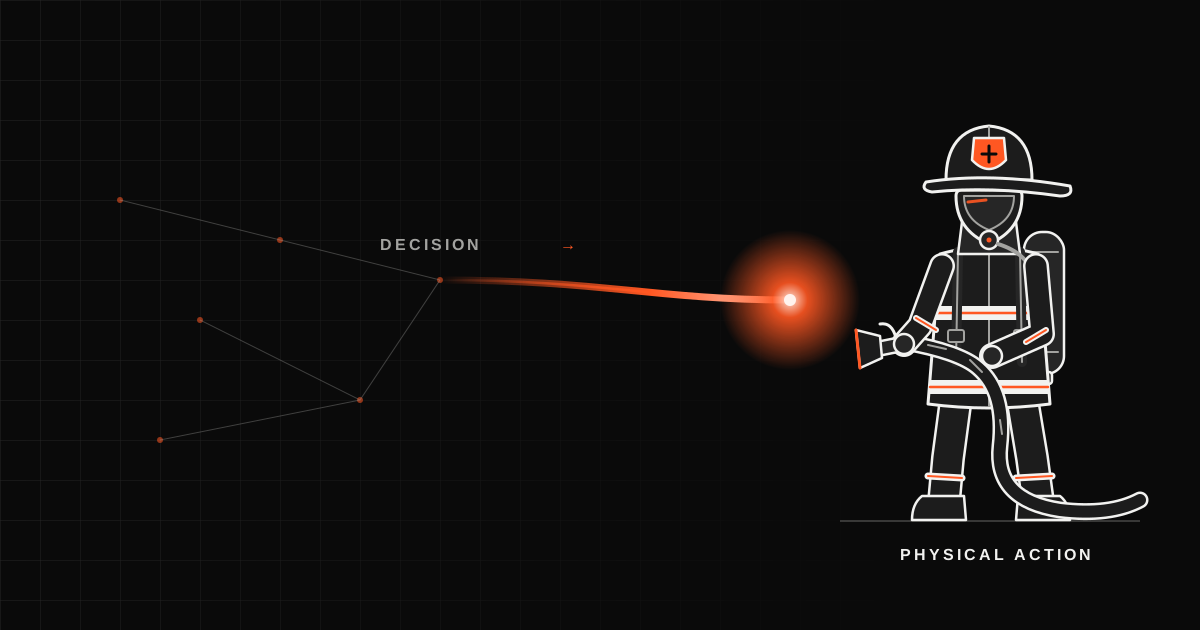
Terminus Edge is the point where a trusted, AI-supported decision becomes physical action through autonomy, robotics, drones, and uncrewed systems. The organizations that master that handoff will hold the advantage.
Watch the concept → Side-by-side animated simulation. Illustrative concept, not doctrine.
[Analysis] This page sets out Terminus Est AI's argument. It is a point of view, not a statistical finding.
Layer 1
Planning, courses of action, and running estimates.
Scenario exploration and wargaming.
Triage, summarization, and fusion of reporting.
Detection and response support.
Supply chain visibility, production, and maintenance.
Layer 2
Platforms that sense, decide within limits, and act when links are degraded.
Ground and maritime robots that go where people should not.
Many inexpensive platforms changing what forces can see and do.
[Analysis] When AI moves from advising people to acting through machines, the character of the fight changes: speed, scale, risk to people, and cost all shift at once.
The seam
Autonomous action is only as good as the decision feeding it. Layer 1 must deliver decisions people can trust; Layer 2 must act on them reliably, under degraded power and connectivity, with a person accountable for the outcome.
[Analysis] The seam, not either layer alone, is where advantage is won or lost. It is also where sovereign, onsite AI matters most: edge systems cannot depend on a distant cloud region staying reachable.
What leaders should do now
Identify where decisions already hand off to drones, robots, or sensors, and where they soon will.
Keep the models that feed edge systems under your control, onsite or sovereign.
Assume power and network loss at the edge and test for it.
Operators and leaders must understand, question, and override what systems recommend.
Use wargaming and simulation to test the handoff before anything moves.
Beyond defense
Drones over search areas and wildfire lines, robots entering hazmat scenes and collapsed structures, and sensors feeding the incident command post. Utilities, plants, and logistics operations face the same seam: trusted decisions feeding machines in the field.
[Analysis] Sourced examples, labeled Verified or Claim, will be added by Terminus Est Lab before this concept is expanded into a full research piece.
Get in touch
To discuss AI advisement or implementation for your organization, we would be glad to hear from you.
Get in Touch